
Posts Tagged ‘Scholastic’
Youngest Filipino Chessmaster gets title at 7 years old!
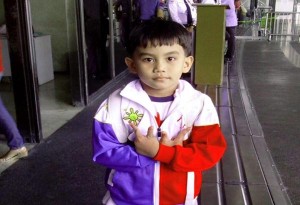
Fide Master Alekhine Nouri
Most kids at 7 years old are watching TV or playing outside, but not youthful Chessmaster Master Alekhine Nouri. He spends his time learning about chess from books and practicing his skils.
“Our daily routine features 10 hours of training; no computer games, no TV. We only ease up on Sundays,” the chess prodigy’s father and personal coach Hamed Nouri said in Filipino.
Alekhine won the title of FIDE Chess Master only 2 years after learning the game. He is the youngest FIDE Master in the world!
Online Chess Lessons!
Online Chess Classes are now available through CheckMatesUSA! We are offering both one-on-one online chess lessons as well as group online chess lessons for multiple students. We have a variety of teachers that can teach chess to all skill levels from absolute beginner to masters of the game. Our teachers can also speak many languages such as English, Russian, Spanish, Georgian, Hindu, and Tamil.
One-on-One Online Chess Classes
One-on-one online chess lessons are great for people of all ages and skill levels that want to get better at chess. Online Chess Classes give you the ability to learn chess from your home. Online chess lessons are the perfect option to help you improve drastically or learn the game quickly because our chess instructors teach at your pace and customize each lesson for you. If you don’t want to pay the high fees of having an instructor drive to your house and don’t want to settle for the low quality of a cheap instructor, one-on-one online chess lessons with CheckMatesUSA are the way to go.
Group Online Chess Classes
We can also offer you group chess lessons online. Working in a group doesn’t give you as much personal attention as one-on-one online chess lessons, but it has other advantages. A lot of people prefer to learn with a group so they have someone to practice their chess concepts with. Group members can be in the same room, but don’t have to be.
How it happens?
Online Chess Classes use free software such as Skype or Google Hangout to connected chess teachers with one or many students. Students are not only able to see the instructor face-face, but also to share the same screen and use an interactive chess board to learn on. With our system, any resource that the teacher has on his/her computer is available to the students during the lesson. This makes learning chess online with us easy and convenient.
If you would like more information about our online chess lessons or to schedule, contact us.
Online Chess Classes are currently on special for $50 a class!
3 vs. 3 Pawn Promotion Problem
When just learning how to play chess, it is important to begin to understand how to use multiple chess pieces together in combination. This doesn’t always mean different types of pieces and even with just pawns on the board a chess player can often calculate to find the best one. This is one of my favorite examples because it is simple enough that someone who just knows how to move pawns can solve it, but its complicated enough to show a beginners the beauty of using pieces together in combination.
Here we go: Imagine you have this position set up:
As you can see, both teams have only three pawns. and in this puzzle it is whites goal is to get to the other side with one pawn. How do you do this?
Give it a try first, the answer is below.
So how do we solve this problem? One important aspect is to look ahead into all the option, now just the obvious.
Lets start with the f5 pawn. If you move this pawn forward, how can black block white’s advance?
Black can just move his pawn to g6 from g7 and white cant do anything. So this doesn’t work. Lets move on.
If we move the g5 pawn to g6, is there any way to win?
The first thing to notice is that black must capture the pawn, or the pawn will capture on either h7 or f7. After black moves his h7 pawn to capture g6, can you find what white should do?
If white captures back, nothing good comes from it. Both pawns end up stuck. Look below:
So what does white do? Well, are you ready? Try it yourself first?
White should move his f5 pawn to f6. Check out the chess position below.
If black captures the pawn on f6, whites pawn on h5 has a clean file that it can get to the other side without problem. If black captures the pawn on h5, the white pawn on f6 will capture on g7 and get to the other side to win.
Hope you enjoy Dr. Connolly!
Chess is a Symphony of Pieces
When teaching chess to kids its important that you find a way to explain chess theory in a way that related to them. Many kids enjoy music and even play musical instruments; so with them I try to relate chess to music.
Chess is very much like music, and a good chess game could easily be compared to a beautiful musical composition. Just think of each piece as a musical instrument. In a good musical composition all the instruments are working together create something that people would enjoy listening to. A song with just one or two musical instruments wouldn’t be as interesting and fun as one with many more.
In chess you are also creating a composition. Like a composer with his or her instruments, a good chess players uses all his or her pieces together in combination to achieve a goal. Just like a composer, a chess player’s personality shows a lot in their chess game.
Its no coincident so many musicians are also chess players, and vice versa!
How the Pawn Moves
The Pawns are always the smallest of the pieces, and you should have eight of them. They will go on the second and seventh rows. White on the second row (a2, b2, c2, d2, e2, f2, g2, h2) and black on the seventh row (a7, b7, c7, d7, e7, f7, g7, h7).

The pawn is my favorite chess piece and also a very unique one. The pawn usually only moves one square forward. The pawns have the ability to move two squares forward if they have never moved before and only one square forward afterwards. They can also just go one square forward on their first turn. They are the only piece that cannot go backwards, and also the only one that attacks differently than it moves. A pawn attacks on a diagonal.

The white pawn on f4 captures the black pawn on e5 and takes over its square.
Attacking in chess is different than in checkers, as the attacking piece does not skip over the piece, but actually captures it by taking over its square.
Chess Tournament this Saturday!
This Saturday we will be having a kids chess tournament at Elk Grove Village Library from 1:30 - 3:00. All kids from grades k- 6th are welcome to come, even beginners! Kids will be separated into two sections: Beginners and Intermediate/ Advanced. Everyone will leave with a prize and first place will leave with an even COOLER PRIZE!
Residents of Elk Grove can register now, while residents of other townships will have to wait until Friday to register. The library can be reached at 847-439-0447.
What is a pawn chain?
Pawn are the first piece that most players learn…but are by no means the simplest. They are a very unique piece for a variety of reasons:
1. They are the only pieces that cannot move backwards.
2. They are the only pieces that attack differently that they moves.
3. They are the only pieces that can be promoted.
Pawns are actually my favorite piece for these and many other reasons, but enough about pawns. Pawn chains are one the first strategies that a chess players learns when dealing with pawns. A pawn chain in when a group of pawns are in a diagonal protecting each other. This is beneficial because the pawns are much harder to attack for your opponent, and easier to defend for you. The pawn at the bottom of the pawn chain the only vulnerable one and therefore you can focus your defenses on him. Later on, more advanced players learn to coordinate their pawn chains with the color of their bishop. Having many pawns chains on the board leads to a closed position and is very powerful for a knight.
Discovery Attack!
A discovery attack is one of the best tactics that a player can use in a chess game. It is a chess tactic that will distract your opponent from your main attack…then if they don’t notice…DISCOVERY ATTACK!
Here’s how it works:
In this position (We are playing as white) we can use a discovery attack to win our opponents Queen and eventually win the game. Our Knight on e3 can move anywhere it wants to without fear or being taken, as our Rook on e2 will be attacking the opponents king and creating the discovery attack. In this instance, it is actually a discovery check, which is the best kind of discovery attack. Can you figure out where we should move our knight?
…
..
.
If you are thinking f5 you are correct. By moving our knight to f5 we can attack the Queen and create a discovery check with our rook. The Queen is now lost for black, as it can only go to e3 or e6 to stop the discovery attack and both moves will lead to it being taken.
Free Chess Classes at Des Plaines Library!
CheckMates Chess Academy will be holding a series of chess classes for kids of various ages and levels at the Des Plaines Library. Kids Chess Classes start will he held on October 8th and 15th. The beginning chess class, which will go over how to play chess including how the pieces move as well as check and checkmate, will be held from 1:00 - 2:30 pm. The strategies chess class will be held from 2:45- 4:15 pm. The strategies class is for kids who already know the rules to chess and want to learn tactics to improve their game as well as fun alternative chess games.
On October 22nd there will be a Kids Chess Tournament where all the kids who participated in chess classes can show off their new skills. Kids who could not come to the classes are also welcome to come; the kids chess tournament will be from 2:00 - 4:00 pm.
The Friends of the Des Plaines Library have sponsored these events and makes it FREE for all the participants! Space is limited, call the Des Plaines Library at 827-5551 to register now!
New Fall Kids Chess Classes Announced!
We are glad to announce our Fall 2011 Classes!
Libertyville Park District Chess Class
Libertyville Sports Complex
1950 N US Highway 45
Libertyville, IL 60048-9720
Mondays from 4:30 to 5:30
Call (847) 367-1502 to register for your child to learn chess.
Morton Grove Park District Chess Class
6834 Dempster Street
Morton Grove, IL 60053
Tuesdays from 5:30 – 6:30
Call (847) 965-1200 to register for your child to learn chess.
Long Grove Park District Chess Class
Reed Woodland Nature Center
3849 Old McHenry Road
Long Grove, IL 60047-5093
Tuesdays from 5:30 – 6:30
Call (847) 438-4743 to register for your child to learn chess.
Lake County Family YMCA
700 Lakeview Pkwy
Vernon Hills, IL 60061-1834
Fridays from 5:00 to 6:00
Call (847) 367-6797 to register for your child to learn chess.
Lake Zurich Park District
200 S. Rand Rd.
Lake Zurich, IL 60047
Wednesdays from 4:30 – 5:30
Call (847) 438-5146 to register for your child to learn chess.
Hawthorn North Elementary School Chess Class
Hawthorn North Elementary School
301 West Hawthorn Parkway
Vernon Hills, IL 60061-1461
Mondays from 3:05 to 4:20
Call (847) 996-6800 to register for your child to learn chess.
Hawthorn Aspen Elementary School Chess Class
Hawthorn Aspen Elementary School
500 N Aspen Dr
Vernon Hills, IL 60061-1616
Tuesdays from 2:20 to 3:35
Call (847) 996-6800 to register for your child to learn chess.
Hawthorn Townline Elementary School Chess Class
Hawthorn Townline Elementary School
810 Aspen Drive
Vernon Hills, IL 60061
Thursdays from 3:15 – 4:30
Call (847) 996-6800 to register for your child to learn chess.
Hawthorn South Elementary School Chess Class
Hawthorn South Elementary School
500 N Aspen Dr
Vernon Hills, IL 60061-1461
Wednesdays from 3:05 to 4:20
Call (847) 996-6800 to register for your child to learn chess.
Akiba- Schechter Jewish Day School
Chicago, Illinois
More After School Chess Classes will be posted soon!
Checkmates USA | Creative Services by D1MA
