
Posts Tagged ‘cool’
Skeleton Key Chess Set
This week’s unique chess set has a Halloween theme…being that October is the spookiest of all the months. The Chess set above is the Skeleton Key Chess Set, and for good reason. All of the pieces are keys and there are slots in the board for them to be inserted into with every move.
I was not able to find the artists deeper meaning behind the board; but was able to come up with a quote for this chess set: “Unlock a new possibility with every move.” This super cool chess set was designed by Dave Pickett.
“There are more moves in a Chess game than there are grains of sand in the world”
When you sit down in front of the chess board, there are twenty possible moves you can make. You opponent can then react in twenty different ways. Already, there are 400 different ways that the first two moves of the game could go. As the game of chess goes on, there are more and more possibilities, with more moves than any person could count. This is where todays famous chess quote comes from.
“There are more moves in a Chess game than there are grains of sand in the world”
Keeping your Cool in Chess
Chess is almost 100% mental; it is because of this it is very important to keep your emotions under control when playing chess (online or not). Many beginner chess players will make a mistake, get frustrated and start moving quickly. This leads them into making even more mistakes on the chess board and their chess position spirals downwards very fast.
The most important thing in keeping a clear mind is to know when yours isn’t. If you have just made a mistake on the board, take a deep breath, relax, understand that things are not going according to plan and that instead of quickly jumping into a new position you need to rethink your position and create a new plan.
Sometimes taking a break helps with keeping a clear mind. Often if I made a mistake on the chess board in a tournament, I would go get a drink of water and cool myself down and stop myself from making a rash impulsive move.
Earth Vs. Space Chess Match
Wow, I had known that chess spanned across the earth…but now chess is spanning the Galaxy!
Thats right, this is a Earth vs. Space Chess Match (which really is a team vs astronauts, sorry to disappoint all of you hoping to play chess against aliens) which is going on live right now! NASA Astronauts Greg Chamitoff and Greg H. Johnson launched into space on May 16th are playing against the Earth Chess Team.
Who you may ask is on this Earth Chess Team? EVERYONE! Anyone can vote to determine the Earths next chess move by visiting here:
http://main.uschess.org/content/view/11169/629/
On the right side of the screen you should see a chess board. When it is Earth’s turn in the Chess Match, a series of options will appear and chess players can then vote on what they think the Earth Chess Team should do. You can also follow the Earth Vs. Chess Match here as well.
Help Team Earth Win!
The “Fast Break” in Chess
The Chicago Bulls are deadly on the fast break! The fast break consists of a basketball team having an advantage in players as they transition on the floor. Take a moment to think which fast break would be better?
A 5 on 4?
A 4 on 3?
A 3 on 2?
or a 2 on 1?
Any basketball player would agree that a 2 on 1 advantage on the fast break is the best. Any mathematician would agree as well. That is because when you are attacking the hoop (like Derrick Rose) with a 2 on 1 advantage, you have a 200% advantage. Compare that to a 150% advantage with a 3 on 2 and only a 133% advantage with a 4 on 3. In chess, like in basketball, you need to capitalize on the advantage before the position changes; hence the Fast Break.
So how do chess players use this information to help them win. Well…When a chess player has the material advantage in the chess game (this means that a player has more chess pieces than their opponent) it is advantageous for them to create even trades. An even trade could be a pawn for a pawn, a knight for a knight, a bishop for a knight, or any trade where a piece of equal value is captured by each team. The less pieces that are left on the chess board, the more that players advantage grows!
If you have the advantage, make sure you capitalize on the Fast Break on the Chess Board before the position changes.
Chess Language- “CheckMate”

The chess phrase CheckMate - to attack (a chess opponent’s king) in such a manner that no escape or defense is possible, thus ending the game - by some theories comes from the Persian phrase ’shah mat,’ translating into ‘the king is defeated.’
Chess in French!
In France, d’échecs (chess), is nicknamed the “Game of Kings.” To listen how it is pronounced in French click Chess in French.
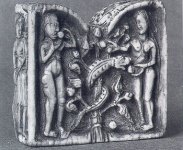
Below is a picture of a Rook dating back to a French chess set from the middle of the 12th century.
Chess and Hockey (Part 1)
With the NHL hockey playoffs going on (and sadly the Chicago Blackhawks are eliminated) I cant help but relate Chess Strategies to Hockey Strategies.In Chess, like in Hockey, the tactics that a player uses change throughout the different periods of the game.
The Chess Game is divided into the Opening, Middlegame, and Endgame.
Hockey is divided into three periods.
In Hockey, a coach who is losing often uses a strategy in the last minute of the game that he would never attempt in the beginning. Often times, a hockey coach will pull their goalie for the last minute of the game because he weights the risk versus the rewards and decides that with the game winding down risking it would be more of an advantage to his team.
In Chess, a player will use different strategies and tactics throughout the chess game. Similar to a coach pulling the hockey goalie, a chess player may take his or her King out of the Castle and use it as a piece. The player must weigh what kind of contribution the King can make on an offensive effort versus the disadvantage he or she may receive from keeping the King exposed.
Whether it is in hockey, chess, or life, kids learn the important of weighing the consequences of their actions for each specific situation.
Finding the Best Move (In Chess & Life)
One of the specialties of CheckMates Chess Academy is making sure kids are able to use the chess skills we teach them in their everyday lives. One of the most important chess skills that a child learns is discipline, the ability to control themselves. This is useful for a variety of purposed in everyday life, but I have found it has helped Behavior Disorder Students very much in specific situations.
In Chess, I always teach children that they must look for more than one possible move, because if they only find one they dont know whether it is the best or worst move for them to make…the have nothing to compare it to. Once they find their top three moves, then they can decided which one of them will work best for the student to achieve a specific goal.
Many chess students use the same type of thinking when encountering a conflict at school. For example, a student in my chess class gets upset because someone has laughed at them, say for a silly mistake they made. This chess student then thinks to himself:
Option A: I feel like crying, but will performing that action lead me to achieving the goals I want?
Option B: I feel like punching the student that laughing at me, but will performing that action lead me to achieving the goals I want?
Option C: I can ignore the other student who is laughing at me, and then focus on achieving the goals I want.
Using this type of thinking, a student naturally learns to weigh his or her actions versus their consequences very quickly in all walks of life. They learn to think ahead of the consequences of their actions, and that the they should always look at more than one route of action to take if they want to find the best one. For most students, just teaching the patience they need to understand that the first move they think of is not usually the best is enough to make a drastic improvement to their decision skills in life. Having this way of thinking teaching kids not to make rash decision. When a student is taught to think ahead and consider multiple consequences on the chess board, they learn to relate it in life. This makes sure that they make every move count, on and off the chessboard.
Playing Chess Without a Board
Chess has been around for over 1500 years in just about every place imaginable. There was even an Earth vs. Space Chess Match held between participants on a team from an elementary school in Washington playing chess against astronaut Greg Chamitoff.
One of the most interesting things about chess is that it can be played without a board. Most people have heard phrases such as e2 to e4 and Knight c3 to d5; this is something called chess notation. Chess players use this to write down their games and be able to look over then for review later. This also allows a player to play chess in their mind, using an incredible amount of visualization and memory skills. Chess players can play chess in their minds by letting their opponent know where they have moved, in chess notation, and visualizing a chess board. Some chess player can play multiple games in their head at the same time!
Teaching your child to play chess in their mind can be one of the most challenging and rewarding things to achieve. Children have the innate ability to visualize and have the potential to increase their memory skills to incredible heights. There are special technique that I teach students that want to learn to play chess in their minds. If you are interested in learning more please contact me.
Checkmates USA | Creative Services by D1MA
